OTC Requirements for HGV Operators to Conduct Workshop Audits

Ensuring vehicle roadworthiness and maintenance compliance is at the heart of every operator’s licence. While the Office of the Traffic Commissioner (OTC) does not explicitly require operators to conduct workshop audits, they are strongly recommended as part of good practice—and are often a key focus in DVSA investigations and Public Inquiries.

In this blog, we explore the role of workshop audits in supporting HGV operator compliance and outline what’s expected.

Why Workshop Audits Matter

Regular workshop audits help operators:

  • Identify non-compliance before a DVSA inspection or Public Inquiry
  • Strengthen operator licence compliance and reduce the risk of prohibitions
  • Meet FORS, Earned Recognition, and other audit scheme standards
    Avoid OCRS penalties caused by poor maintenance practices

Whether your maintenance is in-house or outsourced, audits provide clarity, accountability, and confidence that standards are being upheld.

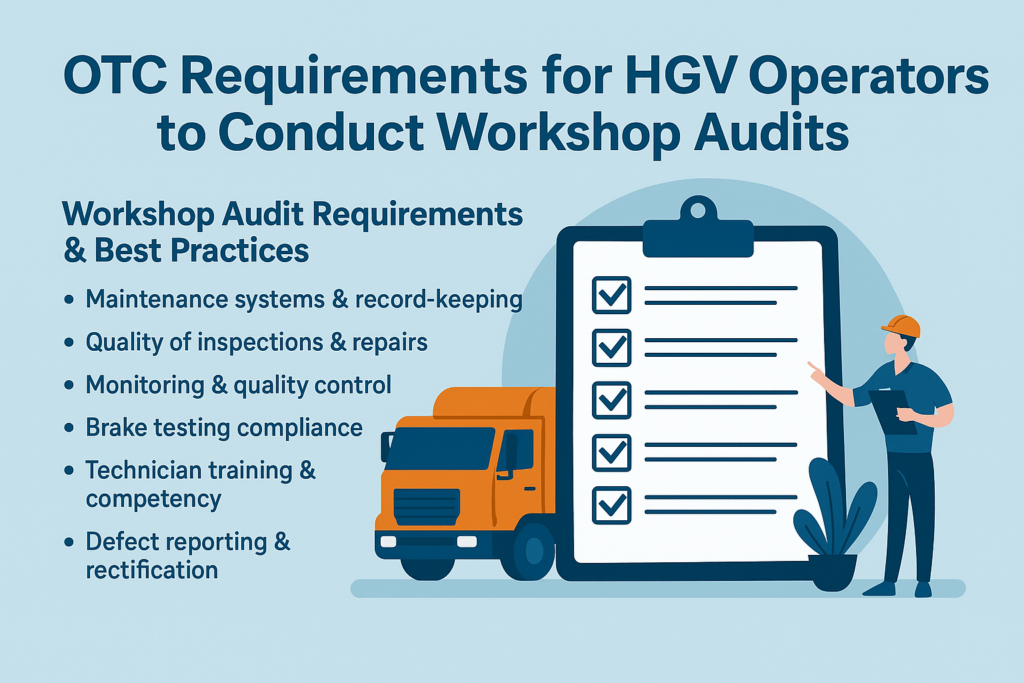
Workshop Audit Requirements & Best Practices

1. Maintenance Systems & Record-Keeping
  • Maintain a robust vehicle maintenance system.
  • Keep safety inspection records, defect reports, and repair logs for at least 15
    months.
2. Quality of Inspections & Repairs
  • Vehicles and trailers must be inspected every 6–8 weeks (or as per operating schedule).
  • Technicians must use suitable equipment and carry out repairs competently.
3. Monitoring & Quality Control
  • If using a third-party provider, ensure they meet DVSA standards.
  • Internal workshops should undergo routine checks or independent audits.
  • Audits help identify gaps before issues become enforcement actions.
4. Brake Testing Compliance
  • Every vehicle and trailer must undergo 4 brake tests per year, including
    the MOT.
  • Audits confirm procedures are correctly followed and fully documented.
5. Technician Training & Competency
  • Maintenance staff must be trained and competent.
  • Third-party technicians must also meet compliance and industry standards.
6. Defect Reporting & Rectification
  • A clear defect reporting system must be in place.
  • Audits ensure issues are logged, investigated, and resolved properly.

How Often Should Workshop Audits Be Conducted?

While there’s no set legal requirement, best practice suggests:

  • Annually for most operators
  • Bi-annually or quarterly for higher-risk fleets or those using external
    maintenance

Regular audits reduce the risk of roadside prohibitions, missed defects, and enforcement notices.

How SH Consultancy Can Help

At SH Consultancy, we offer independent, expert-led workshop audits designed to help HGV operators meet DVSA and OTC expectations.

Our audits include:

  • On-site reviews of maintenance records, systems, and workshop procedures
  • Brake testing and inspection tracking
  • Defect rectification reviews
  • Technician competency and training checks
  • Clear, actionable reports to guide continuous compliance improvements

Need peace of mind and practical support for your workshop compliance? Get in touch with SH Consultancy today to book a free initial consultation.

Let’s protect your operator licence—and keep your fleet safe, legal, and road-ready.

Ready to chat to us? Get Clear, Concise Support for Your Operation

If you require professional support with Transport Compliance, HR, Health & Safety or Road Risk Management, our consultants can provide practical, proportionate solutions aligned with FORS and Mission Zero requirements.

We work with operators of all sizes, providing bespoke consultancy based on your fleet, operating model and risk profile.

Request a quote today to discuss your requirements and understand how we can support your operation. 

    [stmgdpr "I agree with storage and handling of my data by this website. I understand my data will only be used for the purposes of processing my request and will not be sold or given to any unrelated third parties without my consent."]

    ALL SERVICES

    This website uses cookies to enhance your browsing experience and for website analytics. Your data is anonymised and not sold or given to any third party. We are committed to protecting your privacy and ensuring your data is handled in compliance with the General Data Protection Regulation (GDPR).